
For importers and business owners, air freight is often the preferred choice when goods need to be transported quickly and reliably.
However, the high cost of air transport, especially for small shipments, can make some transactions less profitable and even force businesses to pass up opportunities.
To address this challenge, the consolidation method was developed – a process that combines multiple small shipments from different customers into a single larger shipment, allowing for significant savings per kilogram. This approach maintains reasonable transit times while substantially reducing costs, making it an ideal solution for businesses that do not fill a full container themselves but still want to benefit from lower shipping rates.
In this article, we will explore how consolidation works in practice, its advantages and disadvantages, what is required to start using it, and which types of businesses benefit the most.
What Is Consolidation in Air Freight?
In air freight, shipping rates are calculated based on the weight of the cargo (or the volumetric weight – whichever is higher). Generally, the heavier the shipment, the lower the cost per kilogram.
This means that small shipments, even if relatively light, carry a particularly high cost per unit of weight, which can be challenging for importers and small businesses that do not ship large quantities at once.
Consolidation is a shipping method designed to solve this exact problem. In this process, an international freight forwarder combines several small shipments from different customers into a single larger shipment. The consolidated shipment is then sent on a single flight, allowing each customer to benefit from lower shipping costs per kilogram, similar to sending a large shipment independently.
Upon arrival at the destination, the freight forwarder deconsolidates the cargo, separating the combined shipment and delivering each portion to its respective customer. The entire process is managed by the international freight forwarder, including coordination, documentation, customs clearance, and final delivery.
How Does It Work in Terms of Documentation?
In air freight consolidation, document management is a crucial part of the process, enabling shipment merging, proper tracking, and smooth customs clearance at the destination.
The system is based on two main types of Air Waybills (AWB), each serving a different role in the process:
House Air Waybill (HAWB)
- Issued by the freight forwarder for each individual customer – importer or exporter.
- It serves as a binding contract between the shipper and the freight forwarder, detailing the shipment information, terms of carriage, and final destination.
- The HAWB is not directly linked to the airline and is used solely for interactions with the freight forwarder.
Master Air Waybill (MAWB)
- Issued by the airline for the entire consolidated shipment (all combined shipments).
- It is used exclusively by the freight forwarder, who is listed as the main shipper, and not by the end customers.
- The MAWB allows the airline to treat the shipment as a single unit without accessing the details of the individual smaller shipments it contains.
What Does This Mean for You as a Customer?
The freight forwarder manages the entire documentation process, signs agreements with the airlines, and handles all operations – from consolidating shipments to deconsolidation at the destination.
This means you benefit from a simple and organized process without having to deal directly with the airline, but your experience depends entirely on the professionalism and reliability of the freight forwarder you choose.
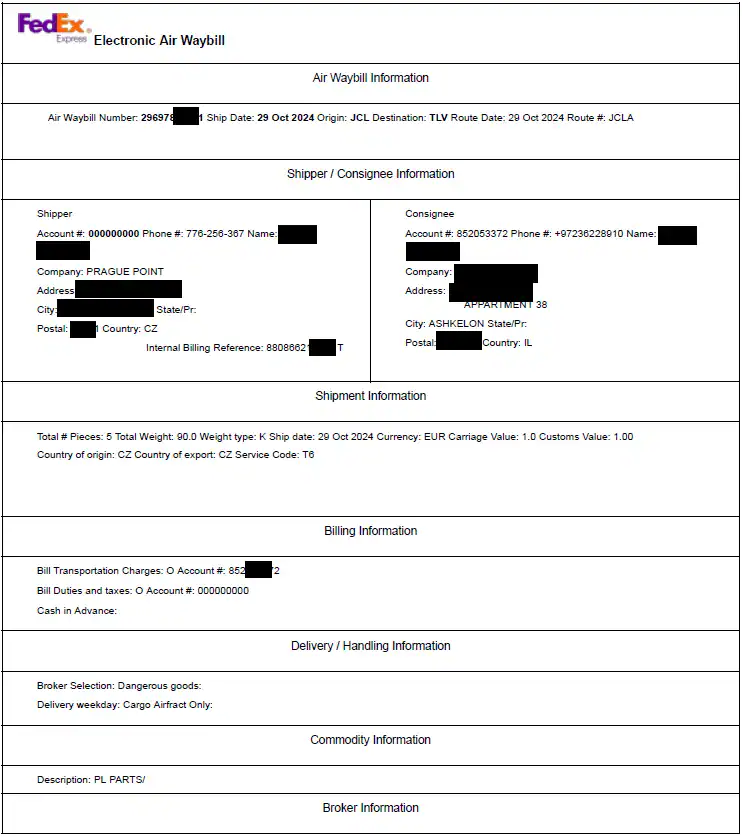
Here is an Example of an Air Waybill (AWB)
Advantages and Disadvantages of Air Freight Consolidation
Before choosing the consolidation method, it’s important to understand that it may not be suitable for every type of shipment or business.
To make an informed decision, it’s helpful to consider both the key advantages and potential drawbacks, and compare them based on your needs, timelines, and budget.
The table below summarizes both sides clearly, allowing you to quickly assess whether this solution is right for you:
| Topic | Advantage | Disadvantage |
|---|---|---|
| Shipping Costs | Significant savings — lower cost per kg thanks to shipment consolidation | For urgent cargo, waiting to complete consolidation may increase costs due to alternative solutions |
| Business Flexibility | Ability to ship small quantities frequently without paying full rates | Dependence on the schedules of the forwarder and other shipments |
| Process Management | The freight forwarder handles all stages, from collection to delivery | Full reliance on the professionalism and reliability of the forwarder |
| Transit Times | Faster than partial sea freight (LCL) | Slower than direct air freight due to waiting for consolidation |
| Additional Services | Option for supplementary services such as packaging, insurance, and customs handling | Complexity in pricing — costs vary between forwarders and handling fees |

The coupon code must be entered during registration on the ShippingToGo website.
Coupon Code – PraguePoint2025
How to Start Using Consolidation
A successful implementation of air freight consolidation begins with choosing the right professionals and understanding the process from start to finish.
Here are the key steps:
1. Choose a reliable and experienced freight forwarder
Look for a forwarder who specializes in air consolidation services and has experience with the routes relevant to your business. Check reviews from previous clients and ensure they have direct connections with the airlines operating the required routes.
2. Verify service availability on desired routes
Not every country or route offers active consolidation services. Confirm in advance that the forwarder can provide consolidation to the destinations you import from or export to.
3. Obtain a detailed quotation
Request a quote that includes all costs – shipping fees, storage, customs clearance, insurance, and any additional charges – to avoid surprises later.
4. Ensure all required documents are ready
Prepare invoices, packing lists, import licenses (if required), and any other necessary forms to prevent delays in cargo clearance.
5. Coordinate pickup and shipment schedules
Since consolidation involves combining shipments from different clients, it’s important to align with the forwarder’s schedule to meet your delivery deadlines.
Summary
Air freight consolidation is an efficient and cost-effective solution for businesses and importers looking to reduce shipping costs without sacrificing the advantages of air transport.
By combining multiple small shipments into a single larger shipment, you can benefit from more competitive rates per kilogram, greater business flexibility, and simpler management of the shipping process.
However, it’s important to remember that this method also has drawbacks – mainly longer transit times and reliance on the freight forwarder. Before making a decision, consider your shipment volumes, frequency, time requirements, and the level of service offered by the forwarder.
When managed correctly, air freight consolidation can become a strategic tool in supply chain management, helping to save costs while maintaining a high level of service for your customers.