

Valid from: October 2025
Next update date: October 2026
Ownership and Management: Prague Point (Partnership No. 558565412)
Address: Hayotzrim 22, Ashkelon
Email: [email protected]
Customer Service: +420-776-256-367

Data Controller and Data Protection Officer


The Data Controller responsible for the processing of personal data on this website is: Prague Point (Israel), represented by Roni Babitski.

Email: [email protected]

For privacy matters, you may contact our Data Protection Officer (DPO): Roni Babitski, residing in the Czech Republic.


The company is not legally required to appoint an external Data Protection Officer under Article 37 of the GDPR.


A. Introduction

The management of Prague Point considers the protection of users' privacy and their rights to be of utmost importance. We undertake to manage the collection and use of personal data in accordance with accepted privacy principles and all relevant laws and regulations on this subject.

The consent to our use of cookies in accordance with the terms of this policy at the time of the first visit to our site allows us to use cookies every time you visit the site.

The website displays a customized cookie management system, which allows users to choose whether to approve or reject the use of non-essential cookies. Third-party components such as analytics and advertising systems will only be activated after receiving explicit consent.

B. Collection of Personal Details

The following types of personal information may be collected, stored, and used:

  • Information about your computer, including your IP address, geographic location, browser type and version, and operating system;
  • Information about your visits and use of the website, including the source of the referral, the length of the visit, page views, and your transition paths on the website;
  • Information, such as your e-mail address, that you enter when registering on our website;
  • Information you enter while creating a profile on our website, for example – your name, profile pictures, gender, birthday, relationship status, interests and hobbies, education details, and employment details;
  • Information, such as your name and e-mail address, that you enter in order to subscribe to our e-mail messages and/or newsletter;
  • The information you enter while using the services on our website;
  • Information generated while using our site, including when, how much, and under what circumstances you use it;
  • Information related to anything you purchase, services you use, or transfers you make on our site, which includes your name, address, telephone number, email address, and credit card information;
  • Information that you publish on our site with the intention of publishing it on the Internet, which includes your username, profile pictures, and the content of your comments;
  • Information contained in messages you send to us by e-mail or through our website, including the content of the message and its metadata;
  • Any other type of personal information you send to us.

Before you disclose another person's personal details to us, you must seek that person's consent for both sharing and processing that personal information under this policy.

In addition to the above, the website and service providers operating on its behalf may use automated technologies such as cookies, web beacons and usage analysis tools, in order to collect technical information during the visit to the website or as part of receiving email messages from the company. This collection is intended to improve the browsing experience, adapt content to user preferences, measure the effectiveness of marketing activities and optimize the website.

C. Use of Your Personal Information

C1. Lawful Basis for Processing

Our processing of personal data is based on one or more lawful grounds under Article 6 of the GDPR, including:

  • Performance of a contract – to provide products or services you have requested;
  • Consent – when you have explicitly agreed to the processing of your data (for example, subscribing to newsletters or accepting cookies);
  • Legal obligation – where processing is required by applicable law;
  • Legitimate interests – to operate, improve, and secure our website and business activities, provided that such interests are not overridden by your rights and freedoms.

C2. Automated Processing and Profiling

This website does not perform any automated decision-making or profiling activities that produce legal or significant effects concerning users.

All processing of personal data is limited to standard analytics, communication, and service delivery purposes.

Personal details provided to us through our website will be used for the purposes specified in this policy, or on the relevant pages on the website. We may use your personal information for the following purposes:

  • Managing our website and business;
  • Personalization of the site for you;
  • To allow you to use the services available on our website;
  • Sending goods you purchased through the site;
  • Delivery of services you have purchased through the website;
  • Sending statements, transaction accounts, and payment reminders to you, and collecting payments from you;
  • Send you commercial messages that are not marketing;
  • Send you e-mail notifications that you have specifically requested;
  • Sending our newsletter to you by e-mail, if you requested it (you can inform us at any time that you no longer need a newsletter);
  • Sending marketing messages related to our business and the businesses of carefully selected third-party companies that we think may be of interest to you, by mail or, in cases where you have specifically agreed to it, by email, or through similar technologies (You can inform us at any time if you are no longer interested in marketing messages);
  • Provision of statistical information regarding our users to a third party (but this third party will not be able to identify any individual user from the information);
  • Handling inquiries and complaints submitted by you or concerning you and related to our website;
  • To keep our website secure and prevent fraud;
  • Verification of compliance with the terms of service that dictate how the website is used (including monitoring of private messages sent through our website's private message service);
  • And other uses.

We may make use of the personal details provided by you, including age information, in order to verify that you meet the relevant legal requirements for the consumption of alcoholic beverages in the country of your residence and to prevent sales to minors.

We will share your personal information with law enforcement authorities and relevant government entities, if required by law or in accordance with a binding legal process, lawsuit, court order or official investigation.

If you provide us with personal information for publication on our website, we will publish the information and use it in other ways in accordance with the license you provide us.

Your privacy settings can be used to limit the publication of your information on our website, and can be changed using the privacy controls on the website.

We will not provide your personal details without your consent to any third party, for the purpose of their direct marketing, or to any other third party.

D. Disclosure of Personal Details

We may disclose your personal details to any of the employees, managers, insurers, professional advisors, agents, suppliers, or our subcontractors, to the extent reasonable and necessary for the purposes stated in this policy.

We may provide your personal details:

  • According to what is required of us by law;
  • In the context of any existing or future legal proceedings;
  • In order to establish, exercise, or protect our legal rights (including providing information to others for fraud prevention and credit risk reduction purposes);
  • To the buyer (or potential buyer) of any business or property that we purchase (or are considering purchasing);
  • And to any person who we reasonably believe may apply to a court or any competent authority for the purpose of handing over the personal details in which it is reasonable in our opinion that the same court or authority orders the delivery of these personal details.

Except as stated in this policy, we will not provide your personal details to a third party.

E. International Data Transfers

1. Your personal data may be transferred and processed in countries outside the European Economic Area (EEA), including the United States, Israel, and other jurisdictions where our service providers operate.

2. These transfers are carried out in compliance with Chapter V of the GDPR. Where no adequacy decision applies, we rely on Standard Contractual Clauses (SCCs) approved by the European Commission or equivalent safeguards to ensure your data remains protected.

3. Our third-party service providers include Google (Analytics, Tag Manager, Workspace), Microsoft Clarity, Cloudflare, Meta (Facebook and WhatsApp), Bing, Canva, and Pipedrive. Each processes data strictly in accordance with its own GDPR-compliant privacy policy.

4. Personal data that you publish on our website or provide for publication may be available worldwide. You acknowledge that such public information may be viewed by others.

F. Data Retention (Saving Personal Details)

1. This section sets out our data retention policy, designed to ensure compliance with our legal obligations regarding the storage and deletion of personal information, in accordance with the principles of necessity, proportionality, and data minimization under the GDPR.

2. We retain personal data only for as long as necessary to fulfill the purposes for which it was collected, or as required by law, regulation, or legitimate business needs. When personal data is no longer needed, it is securely deleted, anonymized, or removed from active systems.

3. The retention periods listed below reflect the maximum duration for which specific categories of personal data may be stored, unless a longer period is required by applicable law or justified by legitimate interests such as dispute resolution or regulatory compliance:

  • Customer details: up to 7 years from the date of the last transaction or interaction.
  • Payment details / credit card information: up to 2 years after the payment date (for accounting verification and fraud prevention).
  • Customer correspondence (emails, contact forms): up to 3 years from the date of the last communication.
  • Browsing data and behavioral analytics: up to 12 months from the date of collection.

4. These retention periods have been determined based on applicable legal obligations, contractual requirements, and our legitimate interest in maintaining accurate business, tax, and accounting records.

5. Notwithstanding the above, we may retain documents (including electronic files) containing personal data for a longer period when:

  • retention is required to comply with a legal obligation;
  • the documents may be relevant to any ongoing or potential legal proceedings; or
  • retention is necessary to establish, exercise, or defend legal claims, or to prevent fraud and mitigate credit risks.

6. Once the applicable retention period expires, personal data is permanently and securely erased or anonymized so that it can no longer be associated with any identifiable individual.

G. Security of Your Personal Details

We operate common security measures, including secure connection (HTTPS), routine system updates and restricting access to personal information only to authorized personnel. However, it is important to know that no system is completely immune, and therefore we cannot guarantee absolute protection of the information.

We will take reasonable organizational and technical precautions to prevent the loss, misuse, or alteration of your personal details.

We will store all the personal details you provide on secure servers (protected by a password and a firewall).

All computerized financial transfers made through our website will be protected using encryption technology.

You acknowledge that the transmission of information over the Internet is inherently insecure, and we cannot guarantee that data sent over the Internet will be secure.

You are responsible for keeping the password you use to access our website confidential; We will not ask you for your password (except when logging in to our website).

All financial transfers and computerized financial information, including credit card information, will be protected by using advanced information encryption technologies, party authentication protocols and up-to-date security standards for online data traffic.

H. Amendments

We may update this policy from time to time by posting a new version on our website.

You should check this page from time to time to make sure you understand any changes made to this policy.

We may notify you of changes to this policy by email or through the private message system on our website.

I. Your Rights under the GDPR

In accordance with Articles 15–22 of the General Data Protection Regulation (GDPR), you have the following rights:

  • Right of access – to obtain confirmation whether we process your personal data and receive a copy of it.
  • Right to rectification – to correct inaccurate or incomplete personal data.
  • Right to erasure ("right to be forgotten") – to request deletion of your personal data, subject to legal limitations.
  • Right to restriction – to request limitation of data processing under certain circumstances.
  • Right to data portability – to receive your data in a structured, commonly used, and machine-readable format.
  • Right to object – to object to processing based on our legitimate interests or for direct marketing purposes.
  • Right to withdraw consent – to withdraw your consent at any time, without affecting the lawfulness of prior processing.

To exercise any of these rights, please contact us at [email protected].

I1. Withdrawal of Consent

You may withdraw your consent to the processing of your personal data at any time by contacting us at [email protected].

Such withdrawal will not affect the lawfulness of any processing carried out before the withdrawal.

I2. Supervisory Authority

If you believe that your data protection rights have been infringed, you have the right to lodge a complaint with the competent supervisory authority:

Office for Personal Data Protection (Úřad pro ochranu osobních údajů - UOOU)
Pplk. Sochora 27, 170 00 Praha 7, Czech Republic
Website: https://www.uoou.cz

J. Third Party Websites

Our site includes external links, and details about, third party sites. We have no control over, and are not responsible for, the privacy policies and procedures of any third party.

Social Networks and Interactive Content

The website may include links to official pages on various social networks, such as Facebook, Instagram, TikTok, LinkedIn and YouTube. These platforms operate according to their own privacy policies, and we are not responsible for how they use the information collected.

In addition, the website may embed widgets, videos and interactive content from third parties. These components may place cookies or collect technical information according to the external service policy.

If the website includes comment areas, forums or open blogs - any information that users provide in them may be accessible to other surfers and the general public. The responsibility for providing personal information in these places rests solely with the user.

K. Direct Mail and Database

By participating, the participant authorizes the company to contact him and send him advertising material subject to the provisions of the Communications Law (Bezeq and Broadcasting), 1982.

The company implements the principles of privacy protection and maintains the rights of customers not to be included in databases for direct marketing purposes without their express consent. Customers may block and/or remove their personal details from the company's databases for marketing use through a written request.

According to the Privacy Protection Law, 1981, every person has the right to review the information held about him in the company's database. A participant who reviewed the information about him and found that the information is not correct, complete, clear or updated, may contact the company with a request to correct and/or update and/or delete the information held on him as stated above. Such a request must be directed to the company by email whose address is: [email protected].

L. Children

The website is not intended for children under the age of 13, and we do not knowingly collect personal information about them. If we learn that personal information relating to a child under the age of 13 has been received, we will act to delete it immediately from our systems. In cases where the provision of personal information is required for the provision of services in accordance with the law, this will be done subject to the required consents and under parental supervision.

M. Leads Management and Automation

The website uses external systems for managing inquiries, leads and business automation, including customer relationship management (CRM) systems and systems for transferring data between different services.

The data transferred includes the information filled in by users in the website forms (such as name, phone, and email) and is used only for the purpose of providing service, managing inquiries, improving work processes and reducing human errors.

The data is stored and processed in accordance with strict information security standards and subject to the privacy policy of each service provider. The information is not sold to third parties, and is used for service purposes only.

PipeDrive – A system for managing leads and tracking incoming inquiries, for the purpose of organizing, documenting and providing quick response to customers. The information collected in the system includes the details filled in by the user in the forms (such as name, phone, and email) and is used only for the purposes of providing service and internal tracking.

N. Cookies

Our website uses cookies. A cookie is a file containing an identifier (a string of letters and numbers) sent by a web server to a web browser and stored in the browser. The ID is sent back to the server every time the browser asks the server to display a web page. Cookies can be either "persistent" cookies or "session" cookies. A persistent cookie will be stored in your browser and will remain valid until the expiration date set for it, unless it is deleted by the user before the expiration date; a session cookie, on the other hand, expires at the end of your current browsing time, when you close your browser. Generally, cookies do not include information that personally identifies users, but personal information that we store about you can be linked to the information stored and obtained from cookies.

The website uses cookies for essential purposes, improving user experience, statistical analysis and personalization. The use of non-essential cookies (such as third-party advertising and analytics systems) is conditional on obtaining user consent through a built-in consent mechanism on the website. Until consent is received - non-essential scripts are not loaded.

Google Analytics – The Google Analytics service on the website will be activated only after receiving user consent, in accordance with the consent mechanism on the website. You can install a browser add-on to block Google Analytics as described below. Until approval - the script is not loaded at all.

To provide website visitors with an additional choice regarding how Google Analytics will collect their data, Google has developed the Google Analytics opt-out browser add-on. The add-on communicates with Google Analytics JavaScript (ga.js) to indicate that information about the website visit should not be sent to Google Analytics. The Google Analytics opt-out browser add-on does not prevent sending the information to the website itself or to other web analytics services.

Microsoft Clarity – The website uses the Microsoft Clarity service, which provides screen recordings, heat mapping and additional usage data to improve user experience and understand user behavior. The service collects anonymous and statistical information about usage patterns on the website, in accordance with Microsoft's privacy policy. Clarity loading is done only after receiving consent from the user through the cookie management mechanism on the website.

Bing Webmaster Tools – The website is connected to Microsoft's Bing Webmaster Tools services for the purpose of monitoring, control and optimization of the website's appearance in the Bing search engine. The service may collect technical and statistical information about website activity and user traffic to it, in accordance with Microsoft's privacy policy. The use of this service is for technical monitoring purposes only, and does not include direct collection of personal identification data from users.

Google Tag Manager – The website uses the Google Tag Manager service, which allows management and embedding of various code tags on the website (such as Google Analytics, advertising pixels and additional measurement tools). The service itself does not collect personal information directly from users, but allows loading of third-party components according to user consent.

WhatsApp – The website integrates a Click-to-Chat button that redirects to the WhatsApp service. When using this button, technical usage details may be collected by WhatsApp (such as IP address and device information). Any use of this service is subject to WhatsApp's privacy policy.

Cloudflare – The website uses Cloudflare services for the purpose of improving performance, traffic routing and protection against cyber attacks. This service may process technical information such as IP addresses, location data and user device information, in accordance with Cloudflare's privacy policy.

Cookie Management and Removal

Most browsers allow you to refuse the use of cookies – for example:

  • Internet Explorer (version 10) – You can block cookies using the cookie bypass settings available by clicking on "Tools," "Internet Options," "Privacy," then "Advanced";
  • In Firefox (version 24) – you can block all cookies by clicking on "Tools," "Options," "Privacy," and selecting "Use custom settings for history" from the drop-down menu, then deselecting "Accept cookies from websites";
  • And in Chrome (version 29) – you can block all cookies by going to the "Personalization and Control" menu, then click on "Settings," "Show advanced settings," and "Content settings," then select the "Block websites from setting data" option under the "Cookies" heading.

Blocking all cookies will have a negative impact on the usability of many websites. If you block cookies, you will not be able to use all the options on our website.

Deleting Existing Cookies

You can delete cookies already stored on your computer – for example:

  • In Internet Explorer (version 10) – you need to delete cookies manually;
  • In Firefox (version 24) – you can delete cookies by clicking "Tools," "Options," and "Privacy," then select "Use custom settings for history," and click "Show cookies," then "Remove all cookies";
  • And in Chrome (version 29) – you can delete all cookies by going to the "Personalization and Control" menu, then clicking "Settings," "Show advanced settings," and "Clear browsing data," then select the option "Delete cookies and other data of sites and plugins," and finally click "Clear browsing data."

Deleting cookies will have a negative effect on the ease of use of many websites.

Our Cookie Management System

The website uses a cookie management system based on custom code, which blocks the loading of non-essential scripts (such as advertising pixels or Google Analytics) until explicit approval from the user. Consent is given by clicking the "Accept" button in the banner displayed at the bottom of the website. Not giving consent will prevent loading of third-party components and block access to website content.

O. Access for AI-based Search Engines

This website allows access to public content by AI-based search engine crawlers, as part of our disclosure and accessibility policy for advanced search engines.

The access is defined in the website's robots.txt file and applies only to publicly available pages. Personal information, secure areas, or non-public content are not accessible to these crawlers.

Authorized crawlers include:

  • GPTBot – OpenAI's ChatGPT reading robot
  • ChatGPT-User – ChatGPT browser extension access component
  • Google-Extended – Google Bard access component
  • PerplexityBot – Perplexity AI search engine robot
  • ClaudeBot – Anthropic's Claude reading robot
  • DuckDuckBot – DuckDuckGo robot including access to public content
  • CCBot – Common Crawl component, an open database relied upon by artificial intelligence models
  • CoHereAIbot, YandexBot, Bytespider, and Amazonbot

This access is strictly limited to indexing of public information and does not involve the collection or processing of personal data. The setup follows professional web standards, ensuring user privacy and protection of sensitive information.

For further questions/consultation, you can contact us at the email address – [email protected]

Importing Samples to Israel What You Must Know

Published on: 08/11/2025
Duration: about 13 minutes
Want to test a product before committing to a large order but aren’t sure how to import samples without running into customs issues?

How many units are allowed?
Which documents are mandatory?
What happens if the supplier ships without a declared value, or if you haven’t requested a standards exemption?

Importing samples may sound simple, but in reality, it requires a precise understanding of the rules, exceptions, and surrounding bureaucracy.

If the product is important to your business, it’s worth taking a few extra minutes to know exactly how to do it correctly.

For businesses looking to test new products before placing large commercial orders, importing samples is a legal and valuable tool.

However, this type of import requires a precise understanding of regulatory requirements in Israel.

This is not just a formal procedure: a single mistake in documentation, exceeding the allowed quantity, or misunderstanding the regulations can result in delays, additional costs, or even destruction of the goods.

That’s why it’s essential to know all the rules-especially regarding the authority that oversees product standards in Israel: the Standards Institution under the Ministry of Economy.


What Is a Sample According to Israeli Law?

In Israel, a sample is defined as goods imported for the purpose of testing, display, or evaluation, and not intended for sale.

In other words, these are items an importer brings in solely for examination before placing a larger order or making a business commitment.

The maximum quantity allowed for importing samples into Israel under HS code 64 is up to 5 units per item, according to the official guidelines of the Standards Institution under the Ministry of Economy.

However, the number alone does not tell the whole story.

Enforcement authorities also consider the purpose of the import, the declaration process, and the overall commercial context.

Samples that appear to be imported in excess quantities, with unusual frequency, or for marketing purposes may be considered an attempt to circumvent regulations and could face customs objections or sanctions.


Exemptions and Approvals for Importing Samples – Who Decides?

The main authority that determines what is allowed and what is prohibited when importing products into Israel is the Standards Institution under the Ministry of Economy.

In justified cases, it is possible to import more than 5 units per item as samples.
However, this is only allowed after submitting a detailed written request to the Director of Standards, including full information on the purpose of the import, the intended use of the samples, and an explanation of why an exemption is required. Approval is granted on a case-by-case basis and only after professional review.

The implication is clear: even when dealing with samples, importers must act carefully, in coordination, and with full transparency toward the authorities.
Attempting to “stretch the limits” when importing samples can be costly.

The request typically includes:

  • Product description
  • Purpose of the import
  • Storage method
  • Intended use of the samples


Such approvals are usually limited in time, quantity, and the location where the samples can be kept.

Many importers assume that samples are automatically exempt from standards requirements-but in reality, this is not always the case.
For products subject to official standards, it is necessary to verify in advance whether an exemption can be granted, based on the intended purpose of the samples.

To facilitate this, importers submit a declaration form to the Director of Standards, in which they confirm that:
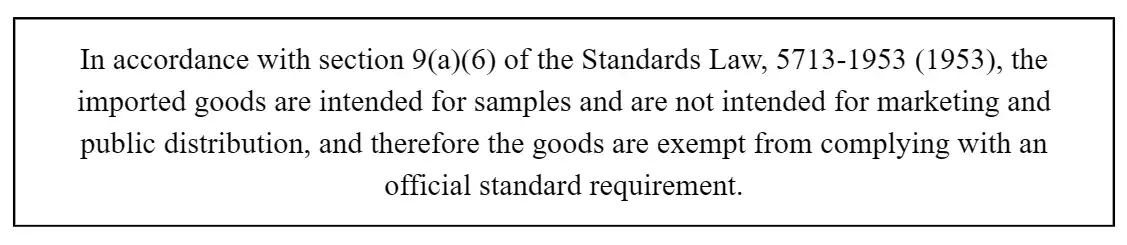


It is crucial to understand that this declaration does not serve as an automatic stamp of approval or exemption.

The Commissioner of Standardization examines each case individually and determines whether to grant approval only after a professional review.

Therefore, even before executing the import, it is advisable to check the following:

Is the product in the sample subject to a mandatory standard? If so, is the declaration alone sufficient, or is a specific, individual approval also required?


Do Not Declare a Value of 0 – Even Samples Have a Cost

A common mistake when importing samples is issuing a commercial invoice with a value of 0.

Suppliers or manufacturers may provide samples for free, but for Israeli customs, the importer must include a realistic monetary value for every item brought into the country-even if symbolic.

Customs uses this value for valuation, classification, and sometimes to verify whether the import qualifies as “personal” or “commercial.

If the invoice shows a value of 0, customs may hold the shipment and request corrected documentation, causing delays or even fines.

Best practice: even if the samples were received for free, issue an invoice with a real value (e.g., $1 per unit) and include a note that these are samples provided without payment.


Samples Are Commercial Imports-Treat Them Accordingly

Even if you’re importing just a few individual items, bringing in product samples is treated as commercial import in every respect. The only difference is the purpose, not the volume.

This means all regulatory obligations that apply to commercial importers also apply to sample imports: registration with the authorities, compliance with regulations, proper documentation, and sometimes even the use of professional customs brokerage services.

Moreover, if the shipment includes items that require specific licensing-such as cosmetics, medical devices, dietary supplements, chemicals, or electrical products-you may also need to coordinate with additional government agencies (e.g., Health, Environmental Protection, Energy), even if it’s only a sample shipment.

Importers are expected to handle documentation and interact with the authorities just as they would for regular commercial imports. In some cases, extra caution is required due to the sensitive legal status of samples.


Early Planning Saves Headaches

Experienced importers know that nothing is costlier than a “small mistake” in the import process…

A sample brought in without proper approval, an invoice with an incorrect value, or quantities exceeding the allowed limit can result in delays of weeks, hefty fines, or even loss of the shipment.

Proper planning starts with the very first conversation with your supplier-requesting an accurate invoice, confirming the nature of the shipment, and preparing all necessary documents in advance. If there’s any uncertainty, seek professional advice rather than assuming “it will all work out.”

This is especially crucial for expensive, sensitive samples or items imported for exhibitions and demonstrations-any delay can directly impact future sales.


What Happens After the Samples Enter Israel?

Once the shipment clears customs, the real work begins. The importer must ensure the samples are used correctly, maintain thorough documentation of testing or display processes, and guarantee that they are not sold or distributed without proper licensing.

In most cases, samples approved under a standards exemption cannot be marketed-even for live demonstrations to clients-unless explicit permission is granted. Violating these rules can result in sanctions, fines, or even restrictions on future imports.

Importing samples is not a “loophole” to bypass regulations-it’s a legal and valuable tool for businesses evaluating products before making commercial decisions. However, it is a sensitive area that requires strict compliance and full transparency, including precise wording on all documentation.

 

This is taken from the appendix titled “Importer’s Declaration for the Import of Goods as Samples.”


In the declaration form for importing goods as samples, there’s a clause requiring the importer to state, “if the goods are imported on behalf of a third party”-underscoring the legal responsibility even when dealing with a small shipment for testing purposes.

When handled correctly, samples save costs, prevent mistakes, and enable an organized process. But ignoring the guidelines can turn them into a real business obstacle.


Importing Samples on a Private or Commercial Flight – What Documents Are Required at Customs?

Many business owners travel abroad themselves to select products and try to save on shipping by bringing samples back in their luggage.

It may sound simple, but from the perspective of Israeli customs, even in these cases it counts as formal importation, and all regulatory requirements fully apply.

For example, imagine an importer in the cosmetics industry flying to the Czech Republic to collect several samples of new products from a supplier. Upon returning to Israel on a commercial flight with the samples in her bag, she must be prepared with the following documents:

  • Commercial invoice – Clearly indicating a real monetary value (even if symbolic), never zero.
  • Importer’s Declaration Form for samples subject to standards – Including a clause confirming that the items are not intended for public sale or distribution (the official form is available for download above).
  • Clear information on the purpose of the import, the quantity of samples, and their intended use.


Upon landing at Ben Gurion Airport, after collecting luggage, there are two customs lanes: green and red.

  • Passing through the green lane implies that you declare you have no items to report. Even if your ultimate goal is to go to the red lane, you cannot “trick” the system.
  • Therefore, you proceed directly to the red lane, approach a customs officer, and request to declare commercial import goods.


The process is brief: the customs officer will ask you to present your goods and relevant documents.

At the conclusion of all checks (including scanning all other luggage, since everything must be declared), the customs officer will issue a “Goods Delay Certificate” for your items.

This ensures that your imported samples are properly declared, compliant with regulations, and legally accounted for.


The goods-which are contained in the suitcase or box you brought to customs-will be sealed with a Customs Seal and sent to the freight terminals at Ben Gurion Airport (TLV). From there, you will be required to collect the merchandise after it has been released by a customs broker.

(Yes, even for importing samples, you still need a professional customs broker to release the consignment.)
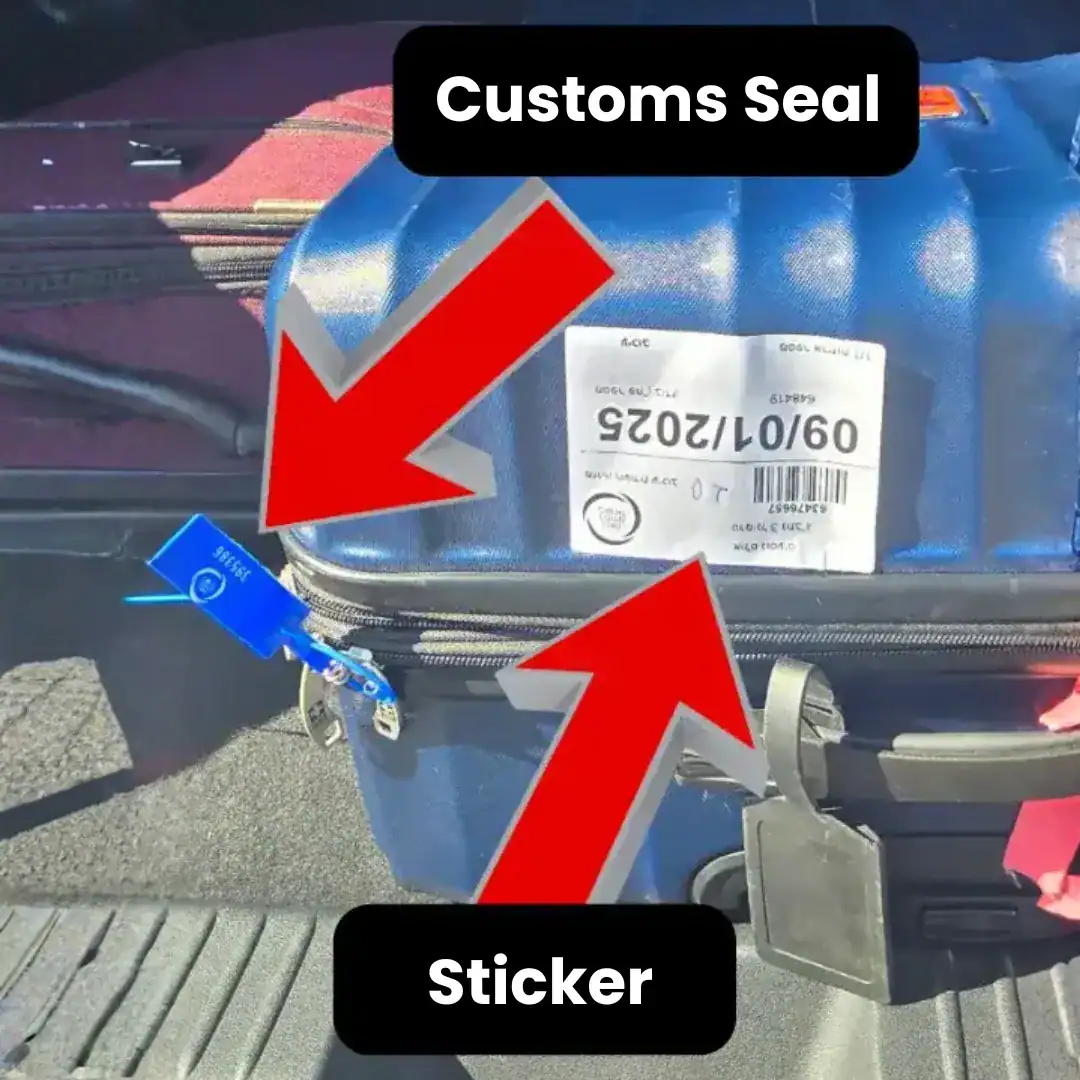
 

Luggage with custom seal and sticker.


Maman Cargo Terminal Operating Information

Maman Operating Hours:

  • Sunday to Thursday: 08:00-16:30

  • Fridays and Erev Chag (Holiday Eves): 08:00-12:45

Address: Hativa 8 Road, Ben Gurion Airport (TLV)

Important Note: It is highly critical that you plan your flight arrival in accordance with these operating hours, as every day the consignment is stored there incurs storage fees. Payment for storage is made at the TLV Seizure Warehouse (enter the gate, turn left, and their offices are on the right side-adjacent to the fence).

Questions and Answers

Can You Import Samples on a Private Flight?

Yes, absolutely. If you're flying abroad for supplier meetings or to attend a trade show, you can bring samples back in your suitcase. However, it's important to understand that once you land in Israel, this counts as a commercial import. This means you must go through the red channel and declare your samples, providing a commercial invoice with a real monetary value-even if the supplier provided the samples for free. Declaring a value of 0 will immediately trigger delays. You also need an importer's declaration form for samples subject to official standards, such as electrical products, cosmetics, or food, and a clear description of the purpose of the import, whether for display, testing, or prototyping. In some cases, a waiver or exemption from the Standards Authority may be required if customs has concerns. Missing even one document can result in a customs seal, storage at the bonded warehouse, and unnecessary delays.

According to the guidelines of the Ministry of Economy, the clear limit is 5 units per item. As long as this quantity is not exceeded, the goods can be declared as samples for internal use, and no special approval is required, provided that the declaration is supported by proper documentation. If there is a need to import more than 5 units, it is mandatory to submit a reasoned request to the Standards Supervisor. The request must include a precise description of the products, the purpose of the import, how the samples will be used, and a business justification for exceeding the limit. Only after receiving explicit written approval can a larger quantity be imported. Any attempt to “cut corners” or bring in an excessive quantity without a request may be considered commercial importation.

No! This is a common-and risky-mistake. When an exemption from presenting an official standard is granted, it is given solely based on the declaration that the products are not intended for marketing, sale, or distribution to the public. The purpose is for display, quality testing, laboratory testing, or presentation to a potential client-not for actual sale. Under regulatory supervision, if it is found that the samples were sold or presented as products permitted for commercial marketing, this constitutes a regulatory violation, which may result in loss of eligibility for future exemptions, financial penalties, and delays or seizure of goods.

No. Even if the samples are individual items and low in weight, marking the package as a personal shipment when it is actually for business purposes is considered a false declaration. Customs authorities can identify commercial shipments based on sender details, type of product, shipment frequency, and value. If it is discovered that a shipment is labeled as "personal" but is actually intended for business, it may be delayed, and the importer could face fines, tax liabilities, and sometimes even the loss of future exemptions. Business sample imports require full transparency, even if the quantity is small. A small attempt to "cut corners" during shipment can turn into a major problem during customs clearance.