


Verified Container Weighing (Verified Gross Mass – VGM) is one of the most significant regulations in the maritime shipping industry.
Its purpose is to ensure that the total weight of each container is accurately known before it is loaded onto the vessel, thereby preventing situations such as imbalance, overloading, or miscalculations in the ship’s capacity.
Since coming into effect in 2016, as part of the International Convention for the Safety of Life at Sea (SOLAS), this regulation has brought about a major shift in how ports, ocean carriers, and freight forwarders operate worldwide.
Today, incorrect or missing VGM information is no longer seen as a minor oversight-it’s considered a regulatory violation that can halt an entire shipment.
In practical terms, this means that every container-without exception-must undergo precise weighing and verification by an authorized body before it can be loaded onto a ship.
This requirement applies to all types of cargo, whether it’s a fully packed container, exceptionally heavy freight, or a mix of smaller items.
Complying with VGM regulations is far more than a bureaucratic formality.
It enables all parties involved-from the shipper to the vessel’s captain-to operate with full confidence in the ship’s weight distribution, helping prevent accidents, costly delays, and potential fines.
What Is VGM and Why Is It Important?
VGM (Verified Gross Mass) refers to the total and accurate weight of a shipping container, including its contents, packaging materials, pallets, and all securing equipment.
Accurate reporting of this weight is crucial to prevent serious errors that could lead to significant risks-such as containers falling overboard, loss of vessel stability, or accidents during loading and unloading. Such mistakes are not rare; over the years, several major maritime incidents have occurred due to incorrect or missing weight declarations.
Moreover, verified weighing allows ship crews and port operations managers to plan container distribution on the vessel safely and efficiently. Proper load planning helps prevent overloading in specific sections, reduces the risk of vessel tilting, and ensures that cargo arrives at its destination safely, on schedule, and without unnecessary damage or delays.
Beyond safety, maintaining accuracy in VGM reporting also protects the reputation of importers and exporters, as it reflects professionalism, accountability, and compliance with international standards-qualities that are essential in today’s global trade environment.
Who Is Responsible for Reporting the VGM?
The responsibility for reporting the Verified Gross Mass (VGM) lies with the shipper, as identified on the shipment’s bill of lading.
Legally, the shipper is the authorized party obligated to provide accurate weight information for the container.
This responsibility includes not only conducting the actual weighing but also calculating the total weight-which must account for the container’s contents, packaging materials, pallets, securing equipment, and the container’s own tare weight (empty weight).
Once verified, the shipper must submit this information to the shipping line and port terminal within the timeframe set by both regulations and the carrier’s schedule.
In many cases, the shipper may not perform the weighing personally but may rely on external logistics providers or freight forwarding companies. However, the legal and regulatory responsibility remains with the shipper. This means that even if a service provider makes an error in the weighing process, the shipper is ultimately held accountable by authorities and shipping companies.
The reporting process must be carried out using approved methods, typically through a designated form or the carrier’s digital reporting system, to ensure full documentation and traceability.
Any delay or incorrect VGM submission may result in the container not being loaded onto the vessel, leading to additional costs and potential disruptions in the supply chain.
How Is VGM Calculated?
There are two primary methods for determining the Verified Gross Mass (VGM):
1. Direct Weighing (Method 1)
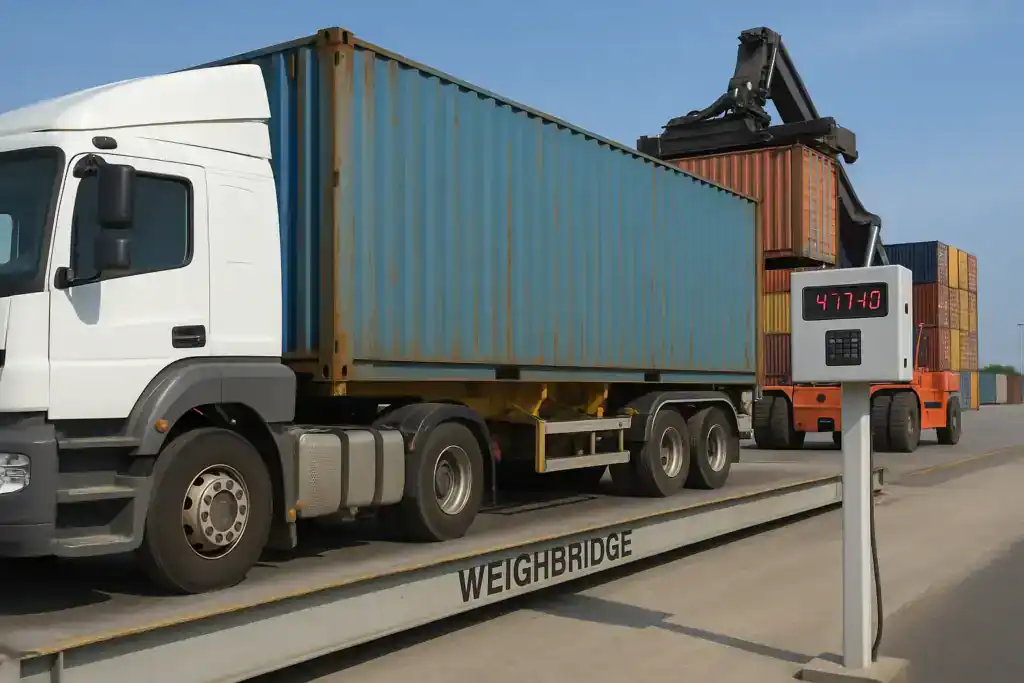
In this method, the fully packed container is weighed at a certified weighing station, typically using calibrated and government-approved scales.
If the container is weighed while loaded on a truck, the truck’s weight (Gross Vehicle Weight) must be subtracted from the total to obtain the container’s exact weight.
This method is considered highly reliable, but it requires access to authorized weighing facilities and may involve additional costs or waiting times.
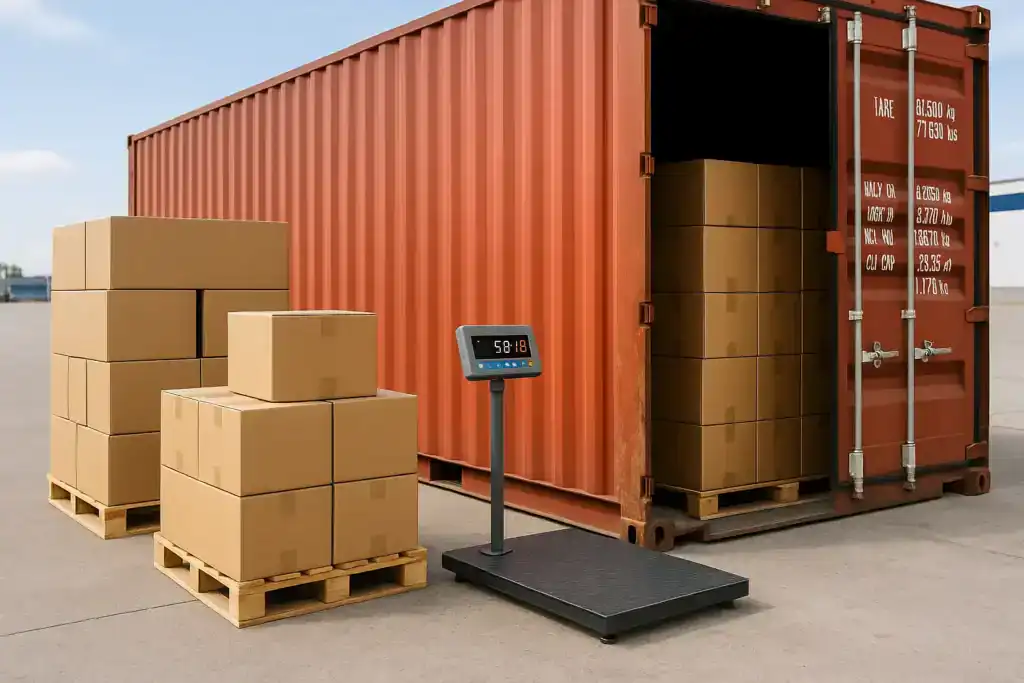
2. Calculation (Method 2)
In this approach, the container itself is not weighed in full. Instead, its total weight is calculated by adding up the weights of all individual cargo items, including packaging materials, pallets, and securing equipment, plus the container’s tare weight (the empty container weight printed on its door).
This method is best suited for homogeneous cargo or shipments where the exact weight of each component is known, but it demands a high level of accuracy and thorough data collection.
Regardless of whether the shipper uses Method 1 or Method 2, it is essential that all weighing is performed using approved, calibrated equipment that complies with local and international regulations.
Failure to meet these standards can result in rejected reports, shipment delays, and potential penalties.
Comparison Between VGM Calculation Methods
| Criteria | Direct Weighing (Method 1) | Calculation (Method 2) |
|---|---|---|
| Process | The fully packed container is weighed at a certified weighing station. | The total weight is calculated by adding up the weight of all cargo components plus the container’s tare weight. |
| Accuracy | Very high, provided certified weighing equipment is used. | Depends on the quality and precision of the data collected. |
| Speed | Slower, as it requires physical access to a weighing facility. | Faster, especially when weight data is already available. |
| Required Equipment | Truck scales or other authorized weighing systems. | No special weighing equipment required-only accurate data. |
| Cost | Typically higher, due to facility fees and potential waiting times. | Usually lower, though depends on the time spent collecting weight data. |
| Recommended Use | For mixed or varied cargo types where exact weights are not fully known. | For uniform cargo where all weight details are accurately available in advance. |
What Happens If the VGM Is Not Submitted on Time?
Failing to submit the VGM on time is not just a technical issue-it’s a serious problem that can completely disrupt a shipping schedule.
Under SOLAS regulations, containers without verified weight data cannot be loaded onto a vessel.
This means that any container lacking a valid VGM report will simply remain at the port, unable to be loaded onto the planned ship.
The direct consequence is a significant delay in the shipping timeline, which can lead to additional expenses such as port storage fees, demurrage charges from the carrier, and extra logistics costs to reschedule transport for a later date.
Moreover, a delay in loading even a single container can disrupt the vessel’s entire stowage plan, potentially causing a ripple effect of delays for other shipments as well.
From a supply chain perspective, such delays can result in contract breaches, missed delivery commitments, and damage to the importer’s or exporter’s reputation.
In some cases, the delay may even require costly alternative solutions, such as rebooking space on another vessel or switching to air freight, which can substantially increase overall shipping costs.
Why Is VGM Critical for Importers and Exporters?
Complying with VGM requirements is not just a legal obligation-it’s a vital operational tool that helps importers and exporters maintain safe, efficient, and profitable business operations.
Regulatory Compliance
Submitting the VGM is a mandatory part of adhering to the SOLAS Convention and local maritime regulations in every country.
Meeting these requirements prevents fines, sanctions, and unnecessary delays, ensuring that cargo can be loaded and shipped smoothly without regulatory obstacles.
Cost Efficiency
Accurate, pre-documented container weights allow for precise planning of loading and transport.
This minimizes additional expenses such as rebooking cargo on another vessel, arranging costly last-minute air freight, or paying for extended port storage.
Enhanced Safety
Knowing the exact container weight reduces safety risks both at sea and during loading and unloading operations at the port.
The ship’s stability, crew safety, and cargo integrity all depend on verified and accurate weighing.
It’s important to understand that in global shipping, weight inaccuracies don’t just result in fines-they can lead to serious consequences such as vessel capsizing, personal injuries, or the loss of valuable cargo.
Maintaining VGM accuracy is therefore essential not only for compliance, but for the safety and reliability of the entire supply chain.
In Conclusion
The VGM regulations are far more than just another formal requirement in maritime shipping-they are a key mechanism for ensuring safety, efficiency, and continuity across the global supply chain.
Compliance guarantees proper load planning, vessel stability, accident prevention, avoidance of fines, and reduced financial risk.
For importers and exporters, a thorough understanding of the requirements, weighing methods, and reporting timelines is a smart investment.
Whether using direct weighing or the calculation method, the most important thing is to ensure accurate data, approved equipment, and strict adherence to reporting deadlines.
Ultimately, investing time and resources in verified weighing helps save money, prevent complications, and ensure a smooth, safe, and reliable shipping process-so that every shipment reaches its destination exactly as planned.
Did You Know?
The global VGM weighing requirement was introduced after a dramatic incident in 2007, when the cargo vessel MSC Napoli lost about 660 containers during a storm-due to inaccurate weight reporting.
The subsequent investigation revealed that around 20% of the recovered containers were significantly heavier than declared.
In fact, 137 of them weighed a combined total of 312 tons more than what was originally reported.
The accident, which cost an estimated £120 million, led to an extensive salvage operation that lasted more than two years-and ultimately underscored the critical need for verified, accurate container weights in global maritime shipping.